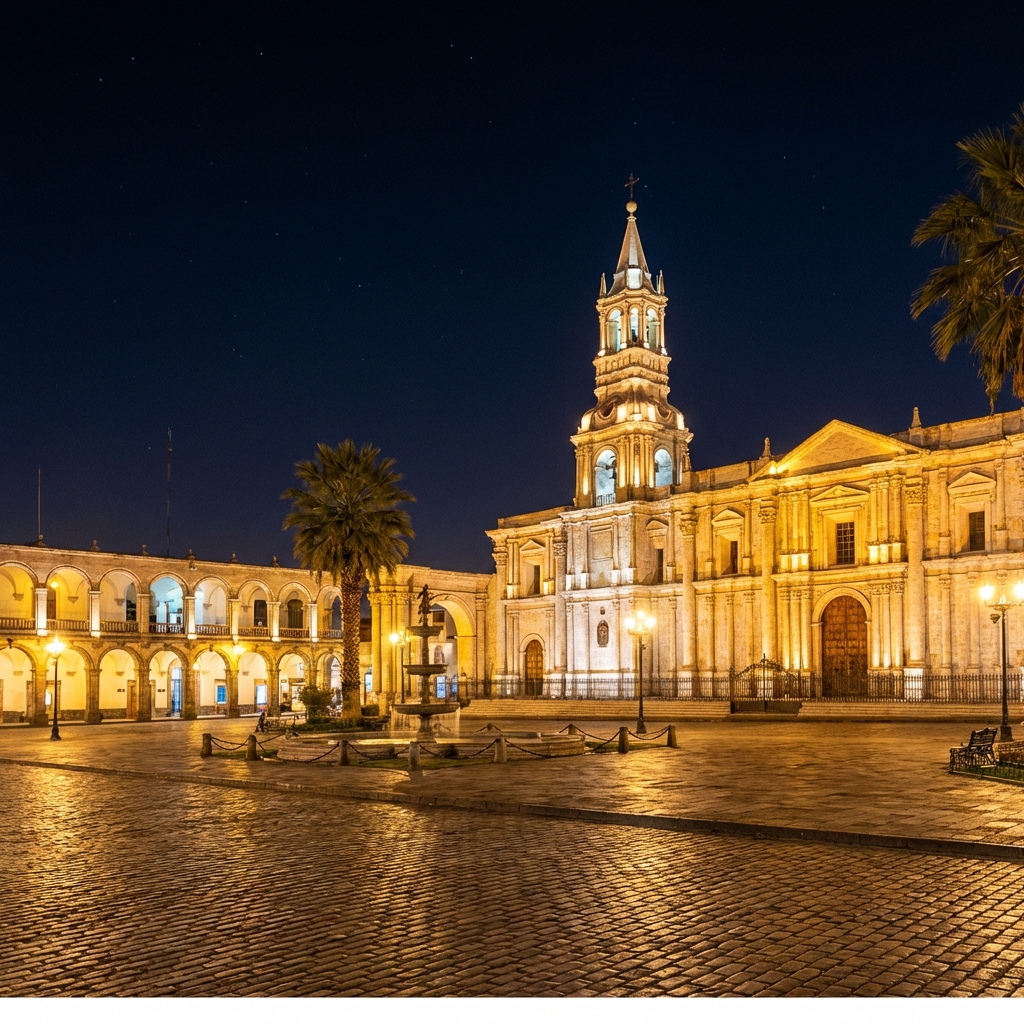
The Cathedral of Arequipa is considered one of the most important religious monuments in the city. Its original construction began in 1540, the same year the city was founded. However, what we see today is the result of multiple reconstructions due to the intense seismic activity in the area.
An Humble Beginning
The first church was built with simple materials such as mud and straw. It wasn’t until the 17th century that sillar, the white volcanic stone that gives Arequipa its name “White City,” began to be used.
Disasters and Resilience
Over the centuries, the cathedral has survived several devastating earthquakes and fires:
- 1600: An earthquake seriously damaged it.
- 1844: A fire consumed much of the interior and the towers.
- 1868: The great Arequipa earthquake destroyed the towers, which were later rebuilt.
- 2001: This year’s earthquake caused one of its twin towers to collapse, an event captured on video that went around the world.
Unique Features
It is one of the few cathedrals in the world with a facade that occupies an entire side of the Main Square (Plaza de Armas). In addition, its interior houses an impressive Belgian Loret organ, one of the largest in Latin America, and a pulpit carved in France by the artist Rigot.
Visiting the cathedral is not just an act of faith, but a journey through the history of the resilience of a people who always rise from the rubble.